How does cricket scoring work operates through a regulated framework governing run accumulation, wicket limitations, and over-based time constraints.
This document outlines scoring mechanics as defined by cricket’s Laws and international playing conditions.
The scoring system quantifies match progression through numerical records of runs, dismissals, and deliveries.
Each format applies specific parameters that modify scoring potential and match duration.
How Does Cricket Scoring Work?

This reference details the structural components, rule applications, and documentation standards that constitute cricket’s scoring methodology.
Cricket Explained: A Simple Introduction for New Readers
Cricket matches involve two teams of eleven players operating in alternating batting and fielding roles.
Each team completes one or more innings, depending on the match format.
An innings represents the period during which one team bats.
The batting side fields two active batters simultaneously, positioned at opposite ends of a 22-yard pitch.
The fielding side deploys all eleven players to restrict runs and effect dismissals.
This asymmetric structure defines cricket’s tactical framework.
| Side | Active Players | Primary Function | Secondary Function |
|---|---|---|---|
| Batting | 2 batters on the field | Score runs through legal strokes | Protect the wicket from dismissal |
| Fielding | 11 players on the field | Dismiss batters within the Laws | Minimize run-scoring opportunities |
The Cricket Scoring System Explained: Top 3 Core Elements
Runs
Runs constitute cricket’s scoring unit. Batters accumulate runs through completed exchanges between wickets or by striking boundaries. Each successful traverse between wickets equals one run.
Boundaries award fixed runs: four runs when the ball crosses the boundary after ground contact, six runs when it crosses without ground contact.
Wickets
Wickets represent batter dismissals under Law 32-39. Each innings permits ten wickets before termination, as one batter must remain not out.
Dismissal methods include: bowled, caught, leg before wicket, run out, stumped, hit wicket, handled the ball, obstructing the field, hit the ball twice, and timed out.
Overs
An over comprises six legal deliveries from one bowler. Match formats specify maximum overs per innings, establishing temporal boundaries for scoring.
Wicket loss and over completion independently terminate innings, whichever occurs first in limited-overs formats.
| Component | Unit Definition | Limitation Type | Termination Trigger |
|---|---|---|---|
| Runs | 1 per wicket exchange or fixed boundary value | None (unlimited accumulation) | Innings end only |
| Wickets | 1 per legal dismissal | 10 maximum per innings | Automatic innings termination |
| Overs | 6 legal balls per over | Format-specific caps | Completes innings allocation |
Scoring Beyond the Basics: Extras, Strike Rotation, and Match Context
Extras Classification
Extras represent runs credited to the batting team through fielding infractions or missed contact, not attributed to individual batter statistics.
The difference between runs and extras in cricket determines statistical attribution. Batter-scored runs appear in personal records; extras contribute solely to team totals.
Extra Types and Rules
Wide: Called when delivery passes outside batter’s reach as defined by playing conditions. Awards one run plus any completed runs.
No-ball: Illegal delivery due to bowling infractions. Awards one run plus any runs scored off the delivery. Batter cannot be dismissed except by run out.
Bye: Runs completed when the ball passes the batter without contact with bat or body, attributable to wicketkeeper error.
Leg-bye: Runs completed after ball contacts batter’s body but not bat, provided batter attempted a stroke or avoided being hit.
Strike Rotation
Strike rotation describes the alternation of which batter faces the bowler. Taking an odd number of runs transfers strike; even numbers maintain the same batter on strike for the next delivery.
| Extra Type | Trigger Condition | Base Penalty | Additional Runs | Statistical Attribution |
|---|---|---|---|---|
| Wide | Ball beyond batter’s reach | 1 run | Plus runs completed | Team extras only |
| No-ball | Illegal bowling action | 1 run | Plus runs scored | Team extras only |
| Bye | Ball misses bat and body | None | Runs completed | Team extras only |
| Leg-bye | Ball hits body, not bat | None | Runs completed | Team extras only |
How Cricket Scoring Works in Actual Matches (With Examples)?
| Match Situation | Applicable Rule | Scoring Outcome | Breakdown |
|---|---|---|---|
| Batter strikes ball into field, both batters complete two exchanges | Law 18: Run accumulation through wicket exchanges | 2 runs credited to striker | Team total +2, batter score +2 |
| Batter strikes ball over boundary without bounce | Law 19.6: Boundary runs – six awarded | 6 runs credited to striker | Team total +6, batter score +6 |
| Over contains: 1 four, 1 single, 1 wide, 1 dot ball, 2 singles | Mixed scoring: batter runs (4+1+2=7) plus extras (1 wide) | 8 runs total from over | 7 balls bowled (wide requires re-bowl) |
Match Rules That Directly Affect the Scoreline
Format-Based Over Restrictions
- Test Cricket: Unlimited overs, innings termination by wickets or declaration only
- One-Day International (ODI): 50 overs per innings maximum
- Twenty20 (T20I): 20 overs per innings maximum
Duckworth-Lewis-Stern (DLS) Method
Applied when weather or external factors interrupt play. Recalculates target scores based on resources (overs and wickets) remaining when play resumes. Does not alter runs already scored; modifies chase targets only.
Decision Review System (DRS)
Allows teams to challenge umpire decisions using technology. Each team receives limited reviews per innings. Successful reviews retain review allocation; unsuccessful reviews reduce remaining challenges.
DRS outcomes can reverse dismissal decisions, directly affecting wicket counts and individual batting records.
| Rule Type | Application Trigger | Scoring Impact | Format Applicability |
|---|---|---|---|
| Over Limits | Match format specification | Caps’ maximum scoring duration | ODI, T20 only |
| DLS Adjustments | Weather interruption | Modifies target, not scores | ODI, T20 primarily |
| DRS Reviews | Team challenge initiation | May reverse wicket status | All international formats |
Reading a Cricket Scorecard: What Every Column and Number Means
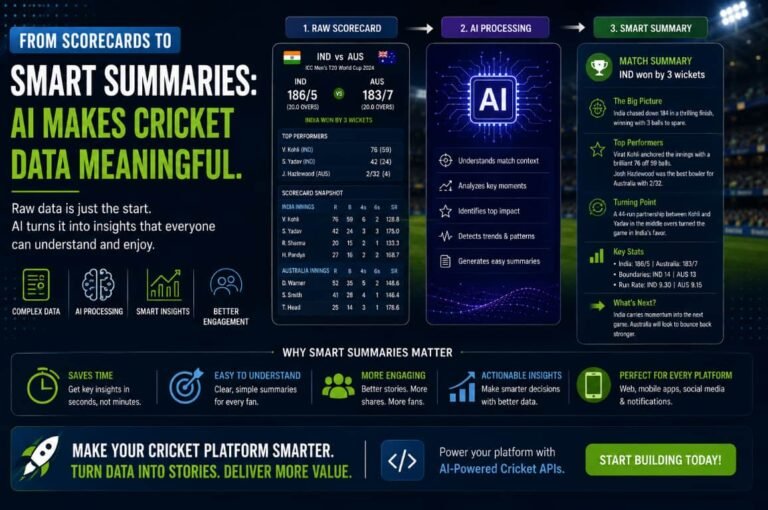
Understanding how to read a cricket scorecard properly requires recognizing standardized column formats and statistical abbreviations.
| Section | Column | Abbreviation | Definition | Value Type |
|---|---|---|---|---|
| Batting | Batsman Name | – | Player identifier | Text |
| Batting | Runs Scored | R | Individual runs credited | Numeric |
| Batting | Balls Faced | B | Deliveries received | Numeric |
| Batting | Fours Hit | 4s | Boundary strokes (4 runs) | Numeric |
| Batting | Sixes Hit | 6s | Boundary strokes (6 runs) | Numeric |
| Batting | Strike Rate | SR | (Runs/Balls) × 100 | Percentage |
| Batting | Dismissal Type | – | Method of getting out | Text |
| Bowling | Bowler Name | – | Player identifier | Text |
| Bowling | Overs Bowled | O | Complete overs. partial balls | Decimal |
| Bowling | Maidens | M | Overs with zero runs | Numeric |
| Bowling | Runs Conceded | R | Total runs off bowling | Numeric |
| Bowling | Wickets Taken | W | Dismissals credited | Numeric |
| Bowling | Economy Rate | Econ | Runs per over average | Decimal |
| Extras | Wide | Wd | Wide deliveries total | Numeric |
| Extras | No-ball | Nb | Illegal deliveries total | Numeric |
| Extras | Bye | B | Missed contact runs | Numeric |
| Extras | Leg-bye | Lb | Body contact runs | Numeric |
| Fall of Wickets | Score-Wicket | – | Team score at dismissal | Score-Number format |
How Live Cricket Scores Are Shown on Scoreboards and Apps?
Live scoring systems display match data in real-time, updating after each delivery. How live cricket scoring works on TV employs graphic overlays synchronized with broadcast feeds.
Core Display Metrics
- Team total and wickets lost (format: 156-3)
- Overs completed and balls in current over (format: 23.4)
- Current batter names and individual scores
- Current bowler name and over figures
Supplementary Display Metrics
- Required run rate (chase scenarios)
- Partnership runs between current batters
- Recent over-by-over breakdown
- Projected score (algorithm-based)
Platform Differences
Television graphics integrate with the visual broadcast, emphasizing real-time ball tracking. Mobile applications provide tabular data with refresh rates between 30-60 seconds. Stadium scoreboards display simplified metrics visible from a distance.
| Display Element | Data Format | Update Frequency | Platform Availability |
|---|---|---|---|
| Current Score | Team: XXX-X | Per delivery | All platforms |
| Overs Progress | XX.X overs | Per delivery | All platforms |
| Batter Scores | Name: XX (XX balls) | Per delivery | All platforms |
| Run Rate | Required: X.XX | Per over | TV, apps only |
| Ball-by-ball | Numeric run values | Per delivery | Apps, websites |
Cricket Scoring at a Glance: Key Terms and Quick Facts
Standardized Terminology
- Innings: Single batting period for one team
- Strike Rate: Runs per 100 balls faced by batter
- Economy Rate: Runs conceded per over by bowler
- Partnership: Cumulative runs between two batters before dismissal
- Duck: Batter dismissed for zero runs
- Century: Batter achieving 100 runs in a single innings
- Five-wicket Haul: Bowler taking 5+ wickets in a single innings
Format Parameters
| Format | Overs Per Innings | Innings Per Team | Over Limit Type | Match Duration |
|---|---|---|---|---|
| Test | No limit | 2 | None | 5 days maximum |
| ODI | 50 | 1 | Hard cap | Single day |
| T20 | 20 | 1 | Hard cap | 3-4 hours |
FAQs
- How does cricket scoring work for beginners?
Cricket scoring records runs when batters complete wicket exchanges or hit boundaries. Teams accumulate runs until losing ten wickets or exhausting their over allocation, whichever occurs first.
- What counts as a run in cricket scoring?
One run equals one completed exchange between wickets by both batters. Boundaries automatically award four or six runs. Extras from fielding infractions also add to team totals without batter attribution.
- How are wickets and overs connected in scoring?
Wickets and overs independently limit innings duration. Ten wickets terminate the innings regardless of overs remaining. Completing allocated overs ends the innings regardless of wickets standing.
- How does the DLS method change scores?
DLS does not alter already-scored runs. It recalculates target scores for the chasing team based on reduced overs and wickets available, maintaining proportional difficulty.
- What information does a bowling analysis show?
Bowling figures display overs bowled, maiden overs, runs conceded, wickets taken, and economy rate. This quantifies bowling effectiveness independent of batting performance.
Conclusion: How does cricket scoring work?
How does cricket scoring work through systematic rule application?
- Run accumulation occurs via wicket exchanges and boundary strokes per Laws 18-19
- Wicket limitations terminate innings at ten dismissals per Law 32-39
- Over restrictions cap scoring duration in limited-overs formats
- Extras add to team totals without individual batter attribution per Law 22
- Boundaries provide fixed-value runs (4 or 6) without physical running per Law 19
- Scorecards document all statistical outputs in standardized formats
Match outcomes depend on comparative run totals achieved within format-specific wicket and over constraints.
Also Check:
About the Author