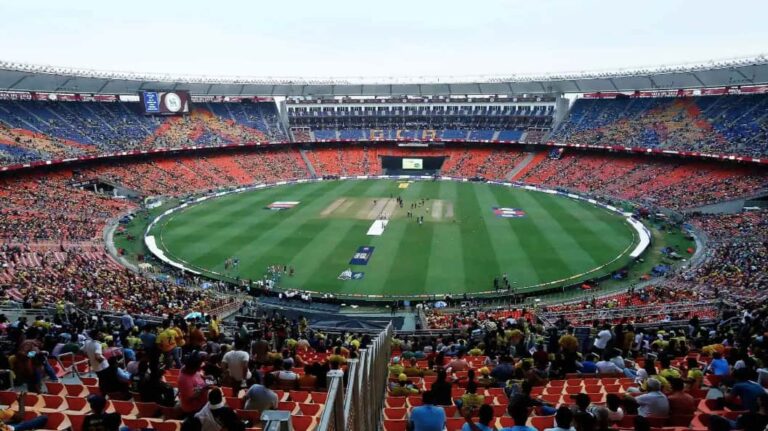
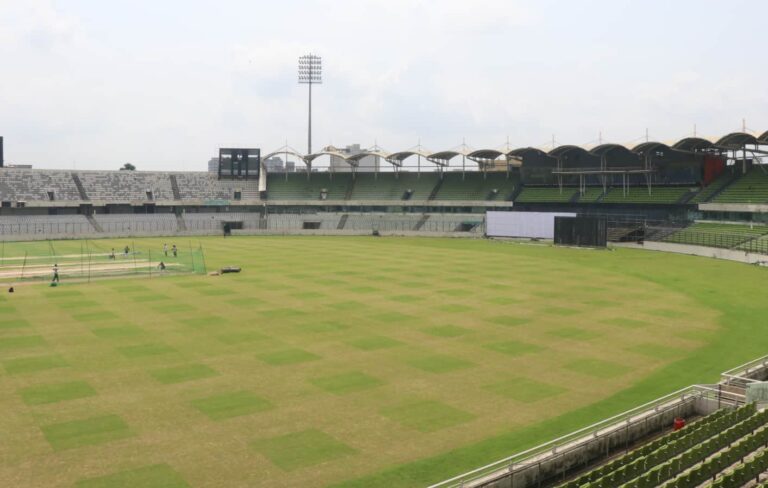
Dubai International Cricket Stadium Pitch Report: Records, Matches, Capacity, Stats
 Karan
Karan The Dubai International Cricket Stadium pitch report provides a detailed analysis of playing conditions at one of the UAE’s premier cricket venues.
This ground has hosted international matches since 2009, developing a reputation for balanced surfaces that shift through different match phases.
The pitch offers seam movement early, spin grip in the middle overs, and batting-friendly conditions under lights.
Teams preparing for matches here need to understand how dew affects evening games and how the surface deteriorates in multi-day cricket.
The venue’s unique lighting setup and boundary dimensions also influence tactical planning.
Dubai International Cricket Stadium Pitch Report

Dubai International Stadium Overview
| Detail | Information |
|---|---|
| Established Year | 2009 |
| Location | Dubai, United Arab Emirates |
| Also Known As | Dubai Sports City Cricket Stadium |
| Ends Name | Emirates Road End, Dubai Sports City End |
| Seating Capacity | 25,000 |
| Shortest Boundary | 59.43 meters |
| Longest Boundary | 64 meters |
| Floodlights | Yes (Ring of Fire system) |
| Pitch Type | Grass |
Dubai International Stadium Pitch Report: Match Phases and Formats
Early Overs / New Ball
Fast bowlers get assistance with the new ball, extracting seam movement during opening spells.
This movement works best in ODIs and evening T20I fixtures when moisture levels are higher. Pacers target stumps and test technique without causing dramatic early collapses.
The grip helps bowlers maintain accuracy and control scoring rates. Batsmen surviving this phase usually find conditions easier as the ball ages.
Early and Later Overs
The pitch settles after powerplay overs, with increased grip for spinners.
Flight variations and changes of pace become more effective than aggressive turns. Teams hosting consecutive matches at this venue see enhanced spin assistance.
Batsmen rotating strike and finding gaps perform better than power-hitters during this phase. Smart placement outweighs boundary hitting between overs 7-15 in limited-overs formats.
Under the influence of light / mist
Evening matches bring humidity that affects ball behavior significantly.
Dew makes the surface skid, reducing spin effectiveness and helping batsmen time shots cleanly. Chasing teams gain clear advantages under these conditions.
Captains winning tosses in day-night matches often bowl first. Final overs see easier batting with the ball coming onto the bat without deviation.
Dubai International Cricket Stadium Records And Statistics
T20I Stats and Records
| Stat | Value |
|---|---|
| Total Matches | 120 |
| Matches Won Batting First | 55 |
| Matches Won Bowling First | 63 |
| Average 1st Innings Score | 140 |
| Average 2nd Innings Score | 123 |
| Highest Total | 212/2 (20 Ov) by IND vs AFG |
| Lowest Total | 55/10 (14.2 Ov) by WI vs ENG |
| Highest Score Chased | 184/8 (19.2 Ov) by SL vs BAN |
| Lowest Score Defended | 98/5 (20 Ov) by NAMW vs UAEW |
ODI Stats and Records
| Stat | Value |
|---|---|
| Total Matches | 63 |
| Matches Won Batting First | 23 |
| Matches Won Bowling First | 38 |
| Average 1st Innings Score | 220 |
| Average 2nd Innings Score | 195 |
| Highest Total | 355/5 (50 Ov) by ENG vs PAK |
| Lowest Total | 91/10 (31.1 Ov) by NAM vs UAE |
| Highest Score Chased | 287/8 (49.4 Ov) by SL vs PAK |
| Lowest Score Defended | 168/10 (46.3 Ov) by UAE vs NEP |
Test Stats and Records
| Stat | Value |
|---|---|
| Total Matches | 13 |
| Average 1st Innings Score | 336 |
| Average 2nd Innings Score | 298 |
| Average 3rd Innings Score | 260 |
| Average 4th Innings Score | 224 |
| Highest Total | 579/3 (155.3 Ov) by PAK vs WI |
| Lowest Total | 90/10 (35.3 Ov) by NZ vs PAK |
Dubai International Stadium: A Batting Pitch or A Bowling Pitch
For batting
- Powerplay scoring window: Batsmen find run-scoring easier after initial seam movement fades. True bounce and consistent pace help stroke-play once the ball softens. Timing improves significantly from over 6-10 onwards.
- Night match batting advantage: Dew during evening fixtures makes the ball skid, eliminating slower deliveries. The Dubai International Cricket Stadium Capacity crowds of 25,00,0 regularly witnessing chasing teams dominate under lights. Second-innings scores reflect this batting-friendly shift.
- T20 high-score trend: Teams regularly post 170-180 in T20 matches here. The Dubai International Cricket Stadium Matches have seen scoring rates increase after major tournaments like the T20 World Cup 2021 and Pakistan Super League fixtures improved pitch preparation standards.
For bowling
- New-ball pace assistance: Fast bowlers extract seam movement during opening spells, particularly in day matches. Morning conditions with a harder ball create the best bowling opportunities. Batsmen face technical challenges without catastrophic collapses occurring.
- Middle-over spin role: Spinners control scoring once the pitch dries and the ball grips. Variations work better than a sharp turn on this surface. The Dubai International Cricket Stadium Stats show spinners consistently take middle-order wickets between overs 8-16.
- Test match surface breakdown: Longer-format cricket sees the pitch deteriorate from day three. Cracks develop, offering turn and uneven bounce. Fourth-innings chases average 224 runs, showing increasing difficulty.
Overall pitch nature
The Dubai International Cricket Stadium Pitch Records indicate balanced conditions favoring neither discipline excessively. First-innings averages of 140 in T20Is, 220 in ODIs, and 336 in Tests show surfaces allowing competitive totals without extreme batting dominance.
Chasing teams hold statistical edges, winning 63 of 120 T20Is and 38 of 63 ODIs when fielding first. Night-match dew drives this trend more than inherent pitch characteristics. Teams defending totals need above-average scores to succeed.
Format variations remain consistent. Limited-overs games produce competitive scores with second-innings advantages. Test cricket offers first-innings runs before gradual deterioration creates results.
FAQs: Questions & Answers
- Q1. When was Dubai International Cricket Stadium built?
The stadium opened in 2009. Its first international fixture occurred on April 22, 2009, featuring Australia versus Pakistan.
- Q2. Is Dubai International Cricket Stadium better for batting or bowling?
Conditions balance between disciplines. Early seam helps bowlers, middle-overs grip assists spinners, and evening dew favors batsmen. Chasing teams hold statistical advantages in white-ball cricket.
- Q3. What is the average T20 score at Dubai International Stadium?
First-innings T20 scores average 140 runs. Second-innings averages drop to 123 runs despite chasing teams winning more matches under lights.
- Q4. What is Dubai International Cricket Stadium seating capacity?
The venue seats 25,000 spectators. Expansion plans aim to increase capacity to approximately 30,000.
- Q5. Who designed Dubai International Cricket Stadium?
Canadian architect Awsam Matloub designed the stadium, including its distinctive “Ring of Fire” circular lighting system with 350 lights.
Conclusion:
The Dubai International Cricket Stadium pitch report confirms versatile surfaces testing skills across match phases and formats.
Strategic considerations include:
- Early-overs approach – New-ball seam movement requires careful batting technique during powerplay overs.
- Middle-phase tactics – Spinners gain control as pitch grips, demanding intelligent stroke rotation and placement.
- Evening advantage – Dew heavily favors chasing teams in night matches, making toss decisions critical.
- Format differences – T20 games see high scores with chasing bias, ODIs follow similar patterns, and Tests deteriorate progressively.
Understanding phase-wise condition changes separates successful teams from struggling sides here.
Balanced surfaces ensure competitive cricket without extreme advantages.
Also Check:
- BRSABV Ekana Cricket Stadium Records
- HPCA Stadium Dharamsala Records
- Most Beautiful Cricket Stadium In The World
- Maharaja Yadavindra Singh International Cricket Stadium Records
- Narendra Modi Stadium Records in Test, ODI, and T20I
- Niranjan Shah Stadium Rajkot Records in ODI, T20I & Test
- Holkar Cricket Stadium Indore Records
- VCA Stadium Jamtha Nagpur Record
- Dr. Y.S. Rajasekhara Reddy ACA VDCA Cricket Stadium Records
- Greenfield International Stadium Records and Pitch Report
About the Author