Cricket websites and apps can now use AI to summarize innings, explain match situations, highlight player performances, answer fan questions and create personalized updates.
For fans, this can make cricket easier to follow. For publishers and app owners, it creates new ways to turn match data into engaging content.
But smarter sports coverage does not begin with AI. It begins with the data layer underneath.
AI can only explain a cricket match properly if it has access to accurate, structured and up-to-date cricket data.
It needs the live score, innings state, scorecard, wickets, overs, player names, match status, result type, venue, format and tournament context.
This is why cricket APIs matter more in the age of AI, not less.
Cricket APIs and AI
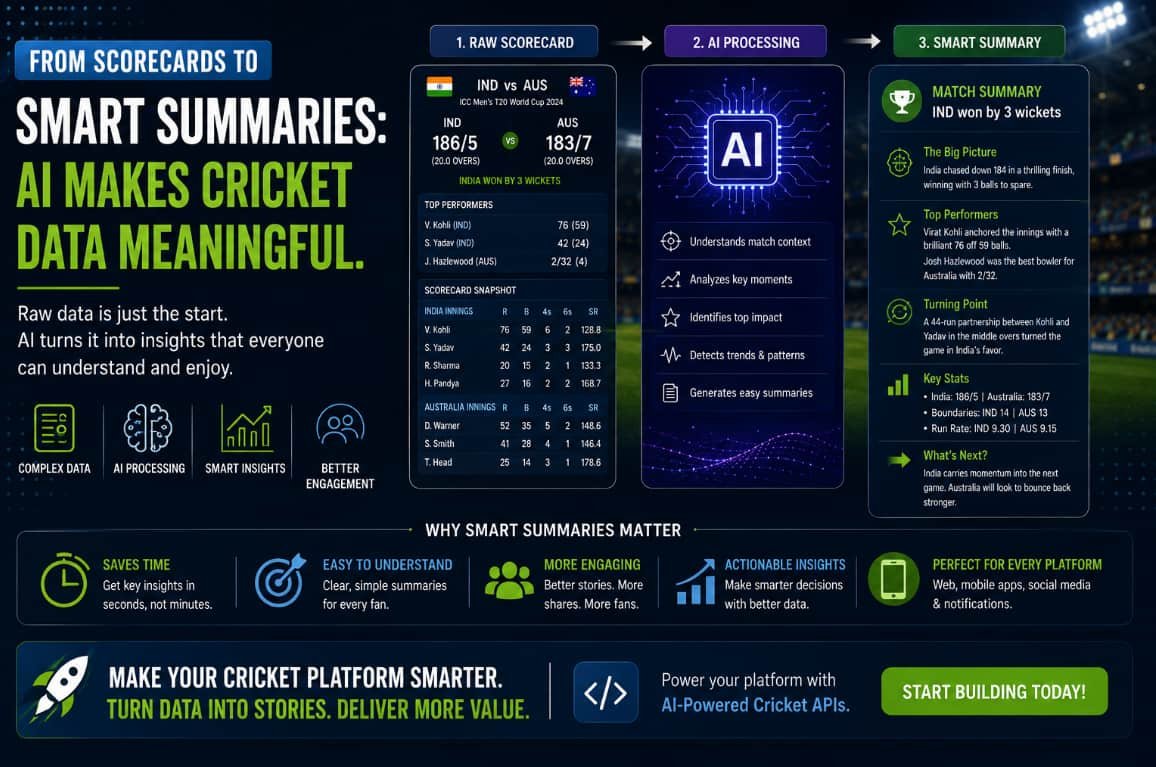
A platform using a reliable Cricket API can give AI the structured match information it needs to produce useful summaries, smarter match centres and more relevant fan experiences.
AI Is Only as Good as the Cricket Data It Uses
AI can write fluent text, but fluency is not the same as accuracy.
A match summary that sounds confident but uses the wrong score, misses a rain delay or misunderstands a revised target is not useful. In sports coverage, trust depends on facts first.
Cricket is especially demanding because the game has many moving parts.
A single match may include multiple innings, hundreds of deliveries, changing run rates, fall of wickets, bowling spells, partnerships, weather interruptions and revised conditions.
If the data layer does not capture those details properly, AI will not be able to explain the match properly.
The most important lesson for sports platforms is simple: AI should not be asked to guess the match. It should be given reliable cricket data and then asked to explain that data clearly.
The Data Layer Behind Smarter Cricket Coverage
When people talk about AI in sports media, they often focus on the visible output: the summary, the chatbot answer, the automated recap or the smart notification. Behind those features is a data layer that does most of the hard work.
For cricket, that data layer may include:
- Fixtures and match schedules
- Live scores and innings state
- Ball-by-ball or recent event data
- Batting and bowling scorecards
- Player names and identities
- Team and squad information
- Venue and format details
- Match status and result type
- Rain delays, interruptions and revised targets
- Historical player and team statistics
Each of these fields helps AI understand the match more accurately. A score alone may say what the total is. The wider data layer explains what that total means.
Why Cricket Needs More Context Than Many Sports?
Cricket is not easy to summarize with one number. A score of 180 can be excellent in one match and below par in another.
A batter scoring 40 from 25 balls may have changed the game, while 40 from 70 balls may have slowed the innings.
A bowler with one wicket may still have bowled a match-winning spell if they controlled the scoring rate at the right time.
AI needs this context if it is going to produce useful cricket coverage. It must understand format, innings stage, target, wickets in hand, pitch conditions where available, recent overs and match situation.
Otherwise, it may produce summaries that are technically readable but not truly insightful.
“Cricket is a game of glorious uncertainties.”
— widely used cricket saying
That uncertainty is part of cricket’s appeal, but it is also what makes the data layer so important. AI can help explain uncertainty, but only if the underlying data captures the state of the match correctly.
Smart Match Summaries Start with Structured Scorecards
One of the most obvious uses of AI in cricket is automated match summaries. These can appear after an innings, after a match or during key moments. But the quality of a summary depends on the quality of the scorecard data.
A basic summary may say who won and by what margin. A better summary can explain that a team recovered from early wickets, built a strong partnership, accelerated in the final overs and then defended the target with disciplined bowling. To write that kind of summary, AI needs structured information about wickets, partnerships, scoring rate and bowling figures.
This is where scorecards become more than historical records. They become inputs for smarter coverage. When scorecards are structured clearly, AI can identify turning points and explain them in language fans understand.
AI Search Needs Reliable Cricket Entities
Another major use case is smart search. Instead of clicking through menus, fans may ask questions directly: “Who is batting now?” “Why did the target change?” “Who took the last wicket?” “What does this result mean for the table?” or “How has this player performed recently?”
To answer those questions, AI needs more than text. It needs reliable cricket entities: matches, teams, players, tournaments, fixtures and scorecards. If player names are inconsistent or match status is unclear, smart search becomes unreliable.
Structured API data makes these answers more dependable. The system can retrieve the correct match, identify the current innings, check the latest score, confirm the player involved and then generate a clear response. Without that retrieval layer, AI may guess.
Personalized Fan Updates Depend on Data Quality
AI also makes personalized coverage more realistic. A fan may want updates only for a favourite team.
Another may want alerts when a specific player reaches a milestone. A fantasy cricket user may care about wickets, catches, strike rate and economy rate. A casual fan may want a simple summary at the end of each innings.
These experiences require clean data relationships. The platform needs to know which player is involved, what event happened, which match it belongs to and whether that event is important enough to notify the user. If the data is messy, personalization becomes frustrating.
Good personalization does not mean sending more updates. It means sending better updates. Reliable cricket data helps platforms decide what matters to each fan.
AI Can Make Cricket More Accessible
Cricket can be complex for newer fans. Terms such as economy rate, DLS, required run rate, powerplay, follow-on and net run rate may not be obvious. AI can help by explaining these concepts in the context of the match.
For example, a casual fan might not know whether 55 runs from 36 balls with seven wickets in hand is a strong position.
AI can explain that the chase is manageable, but that a wicket or two quiet overs could change the situation. That type of explanation makes cricket easier to follow without reducing the depth of the sport.
This is one of the best uses of AI in cricket coverage: not replacing expert fans, but helping more people understand the game.
Documentation Matters Before Building AI Features
Before building AI-powered cricket features, product teams should understand what data is available and how it is structured.
Which fields describe match status? Are scorecards available? Can the product access player statistics? How are fixtures, teams and matches identified? How are delayed or abandoned matches represented?
These questions matter because AI workflows need predictable inputs. Reviewing Cricket API documentation can help teams plan the data layer before they build summaries, smart search or personalized fan features.
Good documentation also helps avoid common mistakes, such as generating summaries before a match result is official, treating a rain delay as normal play or confusing players with similar names.
The Future Is Data Plus Explanation
The future of cricket coverage is not just more data. Fans already have access to scores, scorecards and statistics.
The next step is better explanation. AI can help turn complex cricket information into useful, readable and personalized coverage.
A match centre might show the live score and also explain the momentum shift. A player page might show recent stats and summarize form.
A notification might not only say a wicket fell, but explain why it matters in the chase. A tournament page might explain how a result affects qualification.
These experiences depend on a strong data layer. AI adds the language and interpretation, but APIs provide the facts.
Final Thoughts
Cricket APIs and AI work best together. APIs provide structured, reliable match data. AI turns that data into summaries, explanations, answers and personalized fan experiences.
The mistake is thinking that AI can replace data quality. In cricket, the details matter too much. Overs, wickets, scorecards, match status, rain delays, player performances and result types all affect the story of the match.
Smarter sports coverage will come from platforms that combine accurate cricket APIs with thoughtful AI features. The result will be cricket coverage that is faster, clearer, more personal and easier for every kind of fan to understand.
About the Author