Cricket stats can confuse newcomers. Economy rates, averages, and run rates all measure different things.
But what is the strike rate in cricket? It’s simpler than you think.
Strike rate measures speed. For batters, it shows how fast they score runs.
For bowlers, it shows how quickly they take wickets.
The twist? These metrics work in opposite directions, and that trips up even experienced fans.
What Is the Strike Rate in Cricket?
This guide clears up the confusion. You’ll learn how to calculate both types, understand what counts as good, and see why a strike rate of 150 excites T20 fans but would shock Test cricket purists.
Strike Rate Meaning in Cricket
Strike rate meaning in cricket depends on whether you’re looking at batting or bowling. They measure opposite things.
For batters: How many runs scored per 100 balls faced? For bowlers: How many balls are needed to take one wicket?
This creates confusion. A batting strike rate of 150 is excellent—scoring 1.5 runs per ball.
But a bowling strike rate of 150 would be terrible, needing 150 balls (25 overs) to take just one wicket.
Always check the context. Is the stat about batting or bowling? That determines whether higher or lower is better.
What Is Strike Rate in Batting?
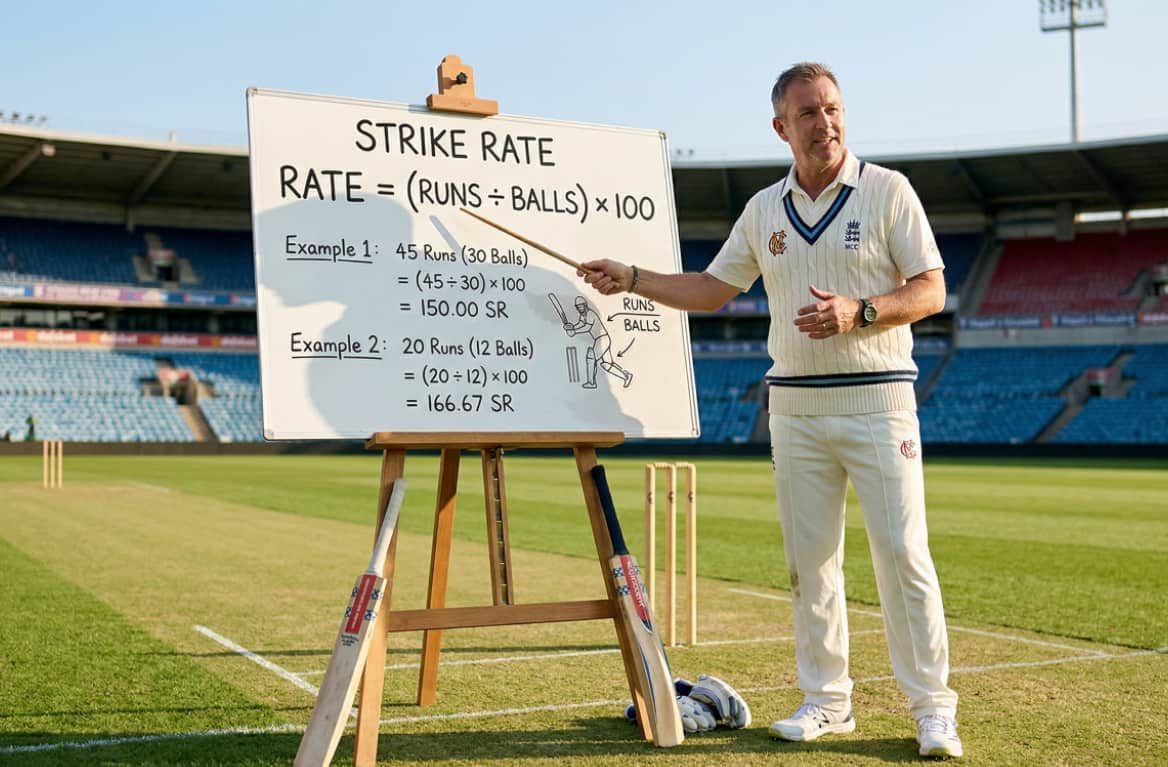
What is strike rate in batting? It’s runs scored per 100 balls faced. Higher numbers mean faster scoring.
The Formula
- Batting Strike Rate = (Runs Scored ÷ Balls Faced) × 100
Real Example
A batter scores 75 runs from 50 balls:
- Strike Rate = (75 ÷ 50) × 100
- Strike Rate = 150
This batter scores 150 runs per 100 balls, or 1.5 runs per delivery. That’s aggressive batting.
Quick Reference
- Strike rate 50 = Scoring half a run per ball (slow, defensive)
- Strike rate 100 = Scoring one run per ball (run-a-ball)
- Strike rate 150 = Scoring 1.5 runs per ball (aggressive)
- Strike rate 200 = Scoring 2 runs per ball (explosive)
In T20 cricket, you’ll see strike rates above 200 in individual innings. In Test cricket, maintaining even 60-70 over a full day shows strong intent.
Bowling Strike Rate Explained
Bowling strike rate flips the logic. Lower is better because it means taking wickets faster.
The Formula
Bowling Strike Rate = Balls Bowled ÷ Wickets Taken
Real Example
A bowler delivers 120 balls and takes 5 wickets:
- Strike Rate = 120 ÷ 5
- Strike Rate = 24
This bowler takes a wicket every 24 balls, or every 4 overs. That’s excellent in any format.
Why Lower Is Better
Taking wickets wins matches. A bowler who strikes every 30 balls is more dangerous than one who strikes every 60 balls, assuming similar conditions and opposition.
Test cricket values bowling strike rates most. Captains need 20 wickets to win a Test match, so bowlers who take wickets quickly are gold.
Strike Rate Across Cricket Formats
Different formats demand different strike rates. What is the strike rate in cricket T20 versus Tests? Completely different expectations.
Test Cricket
Tests reward patience and building innings. Batters occupy the crease for hours.
- Batting: Strike rates of 45-60 are normal. Aggressive batters might reach 65-75. Going faster risks getting out cheaply.
- Bowling: Strike rates of 50-60 balls per wicket are solid. Elite fast bowlers like Dale Steyn or Kagiso Rabada have career rates in the low 40s.
ODI Cricket
One-day cricket balances aggression with stability. Teams face 300 balls (50 overs).
- Batting: Modern ODI batters target 85-100+ strike rates. Scores of 280-350 are common in high-scoring matches.
- Bowling: Taking wickets every 30-35 balls is excellent. But economy rate (runs per over) matters equally in ODIs.
T20 and IPL Cricket
What is the strike rate in cricket IPL? Fast and furious.
- Batting: Strike rates of 130-160 are standard for successful batters. Power hitters like Andre Russell or Glenn Maxwell regularly exceed 170-180.
- Bowling: Bowlers face just 24 balls maximum. Taking 2-3 wickets in that span is valuable, but economy rate matters more than strike rate in T20s.
What Is a Good Strike Rate in Cricket?
Context determines “good.” Here’s a format-by-format breakdown:
Batting Strike Rates
| Format | Good Strike Rate | Excellent Strike Rate |
|---|---|---|
| Test | 50-65 | 70+ |
| ODI | 85-100 | 110+ |
| T20/IPL | 130-145 | 160+ |
Bowling Strike Rates
| Format | Good Strike Rate | Excellent Strike Rate |
|---|---|---|
| Test | 55-65 balls/wicket | Under 50 |
| ODI | 30-40 balls/wicket | Under 30 |
| T20 | 18-22 balls/wicket | Under 18 |
Role also matters. Opening batters in Tests might have lower strike rates than middle-order hitters. Death bowlers in T20s might have higher strike rates than powerplay bowlers.
Highest Strike Rate in T20 International
Highest strike rate in T20 international cricket among regular players belongs to power hitters who changed the game.
Among batters with 500+ runs in T20Is:
- Andre Russell (West Indies): Career strike rate around 165-170. He’s redefined aggressive batting in T20s.
- Glenn Maxwell (Australia): Maintains career rates near 155-160. Known for innovative shots and fearless hitting.
Tim David: Emerging power hitter with strike rates above 160, representing Australia and Singapore.
Single innings records go higher. Players have posted strike rates above 250-300 in individual T20I innings, hitting boundaries almost every ball during brief cameos.
For bowling, the focus shifts. T20 success ties more to economy (runs per over) than strike rate, though taking early wickets in 12-15 balls is valuable.
Strike Rate Formula and Calculator
Already covered both formulas, but here’s the quick reference card:
Batting Strike Rate Formula
Strike Rate = (Runs Scored ÷ Balls Faced) × 100Example: 82 runs from 61 balls = (82 ÷ 61) × 100 = 134.43
Bowling Strike Rate Formula
Strike Rate = Balls Bowled ÷ Wickets TakenExample: 144 balls, 6 wickets = 144 ÷ 6 = 24 balls per wicket
Using Online Calculators
Most cricket platforms calculate automatically:
- ESPNcricinfo: Shows strike rates on all scorecards
- Cricbuzz: Displays live strike rates during matches
- IPL Official App: Tracks player strike rates across seasons
- ICC App: Provides international cricket statistics
Manual calculation takes seconds with a phone calculator. Just follow the formulas above.
Why Strike Rate Matters in Modern Cricket?
Cricket evolved. Twenty years ago, Test cricket dominated. Now, T20 leagues like the IPL generate massive revenue and global audiences.
This shift pushed batting strike rates higher across all formats. Even Test cricket sees more aggressive batting. Teams chase results rather than playing for draws.
IPL franchises pay millions for batters maintaining 140+ strike rates. A player who scores at 130 might not get big auction bids, even with good averages.
For bowlers, T20 cricket shifted focus toward economy rates. But taking wickets in the powerplay (first 6 overs) remains hugely valuable, driving demand for bowlers with low strike rates in those early overs.
Strike rate in cricket transformed from a simple stat into a key performance indicator affecting player selection, team strategy, and contract values.
Frequently Asked Questions
- What is a good strike rate in T20 cricket?
A good T20 batting strike rate is 130-150. Elite batters regularly exceed 160. For bowling, taking wickets every 18-22 balls is solid, though economy rate matters more in T20 cricket.
- How do you calculate strike rate?
For batting, divide runs by balls faced, then multiply by 100. For bowling, divide balls bowled by wickets taken. The strike rate formula differs for batting (higher is better) versus bowling (lower is better).
- What’s the difference between strike rate and batting average?
Strike rate measures the speed of scoring. Average measures consistency—total runs divided by times dismissed. A player can have a high strike rate but a low average if they score fast but get out often.
- Who holds the highest IPL strike rate?
Among players with substantial innings, Andre Russell holds one of the highest IPL career strike rates at 175-180. Players like Sunil Narine and Tim David also maintain exceptional rates above 165-170.
- Is 100 strike rate good in ODI cricket?
Yes, a strike rate of 100 in ODIs is solid. It means scoring one run per ball, which helps post competitive totals. Modern ODI cricket sees many batters exceed 100, with elite players reaching 110-120+.
- What is the bowling strike rate in Test cricket?
Bowling strike rate in Tests measures balls bowled per wicket. A rate of 50-60 is good. Elite fast bowlers like James Anderson, Dale Steyn, or Kagiso Rabada have career rates in the 40s to low 50s.
Conclusion:
What is the strike rate in cricket? For batters, it measures runs per 100 balls higher means faster scoring.
For bowlers, it measures balls per wicket—lower means quicker wicket-taking. Simple concept, opposite directions.
Understanding strike rate helps you read matches better. When a T20 batter has a strike rate of 110 while chasing 180, they’re falling behind the required pace.
When a Test bowler strikes every 42 balls, they’re taking crucial wickets consistently.
Format matters enormously. A strike rate impressive in Tests might be ordinary in T20s. Context always determines value.
Next time you watch cricket, check the strike rates. They reveal whether players are dominating their battles or struggling to keep up.
More Cricket Rules Guides:
- Suspended Meaning in Cricket
- 15 Rules of Cricke
- LBW in Cricket
- Batting Rules in Cricket
- How Many Creases Are There in Cricket
- Test Match Draw Rules
About the Author